Eight weeks out from the Melbourne Marathon, a sharp pain shows up on the outside of your knee somewhere around the 12km mark. It wasn’t there last week. By 15km it’s sharp enough that you’re limping through the last few minutes home.
If this sounds familiar, you’re probably dealing with IT band syndrome, one of the most common overuse injuries we see in distance runners, cyclists, and triathletes during peak training blocks. It responds well to the right approach, and that approach usually has very little to do with the knee itself.
The Anatomy Behind IT Band Syndrome
The IT band, or iliotibial band, is a thick band of connective tissue that runs down the outside of your thigh, from the hip to just below the outside of the knee. It isn’t a muscle, but it’s controlled by one: the tensor fasciae latae, a smaller muscle at the front of your hip that works with your glutes to move your leg out to the side and stabilise your hip when you’re standing on one leg. That happens constantly when you run, ride, or push through the final stages of a triathlon leg.
When the tensor fasciae latae and the IT band are asked to do more work than they’re built for, usually because something else nearby isn’t pulling its weight, the band tightens. That tightness creates friction where the band crosses bony structures near the hip and knee, and it compresses a small fluid-filled sac, called a bursa, sitting underneath it at the knee. Friction and compression are what produce the pain.
How the Pain Shows Up
The most common IT band syndrome symptoms are a sharp or burning pain on the outside of the knee, sometimes alongside pain at the top of the hip. A clicking or popping sensation at the knee is common too, and it’s often mistaken for a ligament or meniscus problem rather than what it actually is: friction and compression along soft tissue.
The pain tends to track along the outside of the thigh. In some cases it spreads further, down toward the outside of the shin. It typically builds the longer you run or ride rather than appearing the moment you start, which is part of why so many people try to push through it for weeks before getting it looked at.
Why Runners, Cyclists, and Triathletes Get It
IT band syndrome in runners often starts the same way: glutes that aren’t pulling their weight, and a tensor fasciae latae that’s picking up the slack.
Glute medius and glute minimus are the muscles responsible for stabilising your hip and controlling your leg as it swings through, whether you’re running, pedalling, or holding an aero position on the bike. When they’re weak, the tensor fasciae latae compensates. Because the IT band runs the full length from hip to knee, that extra workload shows up as tightness and irritation along the whole structure, not just at one joint.
A handful of training factors tend to tip this from manageable to a genuine problem:
- A rapid jump in weekly mileage or session intensity
- A change in running surface, especially a sudden return to trails or hills
- A run that’s heavy on downhill sections, which loads the IT band more than flat or uphill running
- A change in footwear that’s altered how your foot strikes the ground
We see this pattern constantly through RunWest, the run club based out of our Newport clinic. IT band syndrome is one of the most common injuries that shows up as runners and triathletes ramp up their training for events like the Melbourne Marathon or Around the Bay. The timing isn’t a coincidence. Training volume climbs fastest in the eight to twelve weeks before a major event, and that’s exactly when an underlying glute weakness gets exposed.
Treatment That Targets the Actual Cause
Effective IT band syndrome treatment depends on identifying why the band is overloaded in the first place, not just calming the pain down.
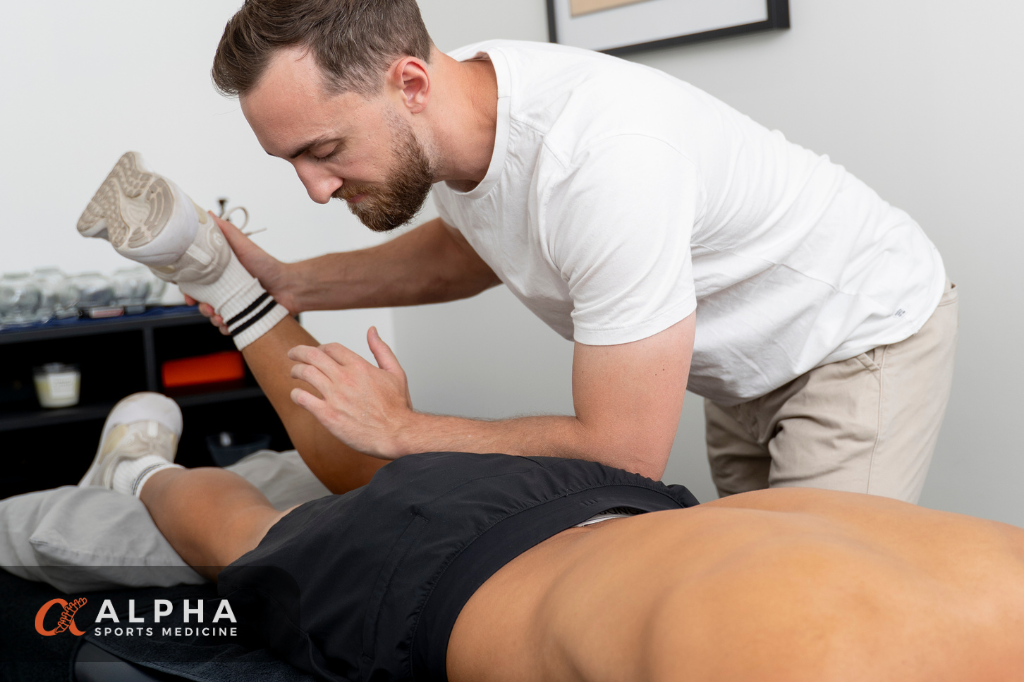
Hands-on treatment still has its place. Soft tissue work and dry needling around the tensor fasciae latae and surrounding hip muscles can bring pain down quickly, and that matters when pain is the reason you’ve stopped training altogether.
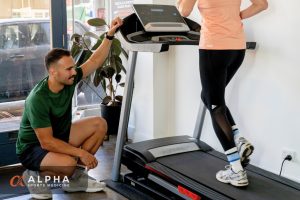
But pain relief on its own doesn’t fix a loading problem. Physiotherapy for IT band syndrome at Alpha Sports Medicine starts with working out why the band is under load in the first place. That usually means a gait assessment, looking at how you run or how you sit and pedal on the bike, to find where load is accumulating and which muscles aren’t doing their job.
From there, treatment runs on two tracks at once: manual therapy to manage symptoms in the short term, and a strength programme to address the glute weakness driving the problem. Doing one without the other tends to produce the same result every time. Pain settles, training resumes, and the pain comes back within a few weeks.
Strength Training to Offload the IT Band
The right IT band syndrome exercises target your glutes, not the band itself. Strength training is the part of treatment that changes the outcome long-term, by building enough capacity in the muscles that should be doing the work.
Targeting Glute Medius and Glute Minimus
These are the deep hip stabilisers, and they respond well to controlled, lower-load exercises early in a rehab programme:
- Clam shell variations, progressing from band-resisted to weighted as control improves
- Crab walks with a resistance band around the ankles or knees
- Standing glute kickbacks, focusing on a slow and controlled movement rather than speed
- Hip-dominant split squats, which load the glutes more directly than a standard squat pattern
None of these need heavy weight to be effective. What matters more is control: a slow tempo, a full range of motion, and avoiding compensation through the lower back or knee.
Building Glute Maximus Capacity
Once the smaller stabilisers are coping with light load, the programme shifts toward glute maximus, the muscle that gives you power and endurance through hip extension. Hip extensions and barbell hip thrusts are the two exercises we lean on most here, building toward heavier loads over several weeks so the muscle can drive movement rather than just assist it.
The aim isn’t to turn you into a powerlifter. It’s to make sure your glutes, not your tensor fasciae latae, are doing the heavy lifting when you’re 30km into a marathon or grinding up a hill on the bike.
Recovery Strategies That Support Healing
Recovery from IT band syndrome works best as a mix of hands-on treatment and things you can do yourself between sessions.
In the clinic, manual therapy and dry needling help reduce tension in the tensor fasciae latae and surrounding tissue. At home, a foam roller through the quadriceps and a trigger point ball worked into the TFL at the top of the hip can do a similar job on a smaller scale.
Hydrotherapy, infrared sauna, and ice baths all have a place too, particularly during a heavy training block when your body needs help recovering between sessions rather than just resting. Nutrition matters here as well. Getting enough protein supports the muscle repair this kind of rehab depends on, and eating enough carbohydrate before endurance sessions makes sure your body has the fuel to perform the way you’re asking it to.
Training Through Marathon and Around the Bay Season
IT band syndrome cases climb every year in the lead-up to the Melbourne Marathon and Around the Bay, and it’s almost always tied to peak training load. The fix isn’t to train less. It’s to build in genuine recovery and catch problems before they sideline you completely.
A few things make a real difference during a heavy block:
- Regular check-ins with a practitioner who understands your training and your goals, so small issues get picked up before they become a reason to stop running or riding altogether
- Recovery days that are actually recovery days. A slow run or an easy spin still loads the same tissues that are already under stress, so a genuine recovery day means manual therapy, mobility work, or simply staying off your legs
- Strength work that continues year-round, not just when something hurts
The runners and cyclists who manage IT band syndrome best are usually the ones already doing hip strength work before running injuries show up, not after.
When It Might Not Be IT Band Syndrome
Outside-of-knee pain isn’t always IT band syndrome. A meniscus injury, a lateral collateral ligament issue, or referred pain from your lower back or hip can produce similar symptoms, and they need a different approach entirely.
A few signs point toward getting checked sooner rather than later: knee instability or a feeling of giving way, swelling that develops quickly after a single incident rather than building gradually, or pain that doesn’t change at all regardless of activity or rest. These patterns suggest something other than the overuse picture typical of IT band syndrome, and they’re worth a proper assessment before starting any rehab programme.
This is part of why a clinical assessment matters before jumping into a generic IT band protocol. The exercises that help a true overuse-related case won’t necessarily help a different underlying issue, and in some cases they could aggravate it.
IT Band Syndrome: Your Questions Answered
| Question | Answer |
|---|---|
| What does IT band syndrome feel like? | Most people feel a sharp or burning pain on the outside of the knee, sometimes alongside pain at the top of the hip. A clicking or popping sensation at the knee is common and is often mistaken for a ligament or meniscus problem. Pain usually builds the longer you run or ride rather than appearing immediately. |
| What causes IT band syndrome in runners and cyclists? | Weakness in the glute medius and glute minimus is the main driver, forcing the tensor fasciae latae and IT band to take on extra work. Rapid increases in mileage or intensity, hilly or downhill training, and footwear changes are common triggers, particularly during peak training blocks for events like the Melbourne Marathon. |
| Can I keep running or cycling with IT band syndrome? | In many cases, yes, with modified load and the right treatment plan. Continuing to train at a reduced volume while addressing the underlying glute weakness is usually more effective than complete rest. If pain is severe or worsening, get assessed before continuing your normal training load. |
| What exercises help IT band syndrome? | Glute-focused strength exercises are the foundation, including clam shell variations, crab walks, standing glute kickbacks, hip-dominant split squats, and hip thrusts. These build capacity in the muscles that should be controlling hip movement, reducing the load placed on the tensor fasciae latae and IT band. |
| How long does IT band syndrome take to heal? | Recovery timelines vary depending on how long the irritation has been present and how consistently the strength programme is followed. Many people notice improvement within a few weeks of starting targeted glute strengthening and load management, though full resolution can take longer for cases that have been present for months. |
Final Thoughts
IT band syndrome is frustrating because it shows up exactly when you can least afford it, usually in the final stretch before an event you’ve spent months preparing for. The pain sits at the knee or hip, but the actual problem almost always traces back to glute strength and how your training load has been building.
Addressing the pain and the underlying weakness together tends to get runners, cyclists, and triathletes back to full training faster than chasing pain relief on its own. It’s also the version of treatment that holds up once you’re back into a full training block, rather than breaking down again the moment volume increases.
Book a physiotherapy assessment at our Ascot Vale or Newport clinic: alpha-sports-medicine-osteopathy.au1.cliniko.com/bookings