
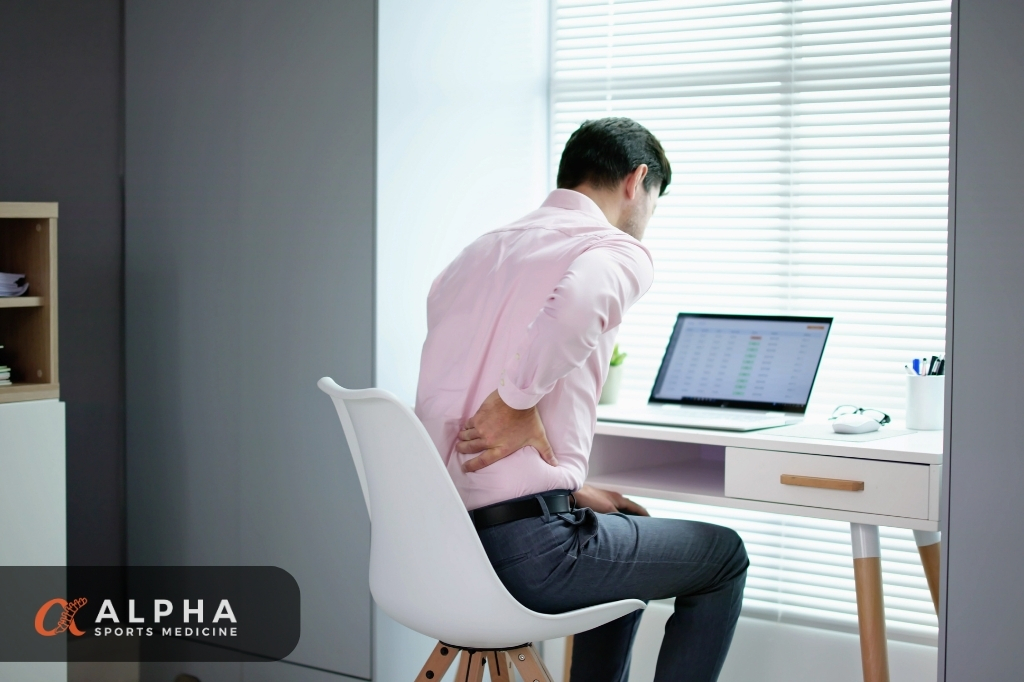
Nine hours at a desk does something to the lower back and hips that most people don’t notice until the pain starts travelling. A dull ache in the glute turns into a hot line down the back of the thigh, sometimes reaching the calf or foot. For a lot of office-based workers, sciatica and sitting go hand in hand, and it rarely shows up out of nowhere. It builds, session by session, out of the exact position most desk jobs put people in for eight hours a day.
Sciatica describes nerve pain travelling down the leg, sometimes into the hip, knee, or foot, and it can show up as sharp pain, numbness, burning, or tingling. The underlying cause is either mechanical, a disc bulge or tight muscle physically compressing the sciatic nerve, or inflammatory, where swelling around the nerve keeps it irritated. The two causes can feel almost identical from the inside, which is part of why a proper assessment matters before treatment starts.
What Your Desk Job Does to Your Sciatic Nerve
Sitting for extended periods does a few specific things to the spine, and they compound each other over the course of a workday. A slumped position, the default posture for most people by mid-afternoon, increases pressure on the spinal discs and holds the sciatic nerve on a constant, low-level stretch. If the nerve is already sensitive, even mild ongoing tension is enough to keep it fired up.
There’s also what happens to the muscles supporting the spine. Picture the spine as a suspension bridge, where the muscles act as the cables holding the structure steady. Sitting switches those cables off. When they go slack, the passive structures of the spine, the discs and ligaments, end up carrying the entire load instead of sharing it. Over months of desk work, that overload adds up, and it’s a significant contributor to sciatic nerve pain in people who sit for a living.
Then there’s the matter of position itself. Staying still means the same segments of the spine absorb the same load, hour after hour, day after day, and that repetition matters more than people expect. A joint or disc that carries a moderate load for ten minutes recovers easily. The same load sustained for three hours starts to compound.
Desk Habits That Quietly Aggravate Sciatica
A handful of everyday habits make sciatica worse for office workers without most people realising it. Sagging into a soft couch or a low, unsupportive office chair keeps the spine loaded in a flexed position for hours. Stretching the legs out in front of the body can pull directly on the sciatic nerve. Sitting with the knees higher than the hips, common in low chairs or when a stool doubles as a desk seat, is another frequent aggravator.
The biggest factor by far is stillness itself. Spreading load across the spine through regular movement keeps any one area from taking on too much. Hours in one spot does the opposite, concentrating compression and irritation in the same place, and that pattern is one of the most common reasons desk workers end up dealing with sciatica in the first place.
Making Your Desk Setup Work for Your Sciatic Nerve
None of this means giving up a desk job. It means paying attention to a few details that keep the sciatic nerve out of a flexed, static position for hours at a stretch. A chair with genuine lumbar support, keeping the knees roughly level with or slightly below the hips, and avoiding the legs-stretched-forward slump all reduce ongoing tension. Building in movement, even short walks every 45 minutes to an hour, interrupts the static loading pattern before it has a chance to build. Good sitting posture matters for sciatica, but the bigger fix is usually simpler: treating desk ergonomics as an ongoing habit rather than a one-off chair purchase.
When Desk-Related Sciatica Needs More Than a Better Chair
Ergonomic changes help, but they don’t always resolve sciatica that’s been building for months. Once a disc or muscle is genuinely compressing the nerve, or ongoing inflammation has taken hold, a chair adjustment alone won’t undo that. That’s where an assessment matters: working out whether the driver is musculoskeletal and treatable, or whether something else needs investigating first.
Sciatica And Sitting: Your Questions Answered
| Question | Answer |
|---|---|
| Can sitting really cause sciatica? | Sitting alone doesn’t create sciatica out of nothing, but prolonged sitting significantly increases the load and tension on structures that can irritate the sciatic nerve, including spinal discs and the surrounding muscles. For people already carrying some vulnerability in the lower back, extended sitting is a common trigger for symptoms to start or flare. |
| What’s the best sitting position to avoid sciatica pain? | Keeping the knees roughly level with or slightly below the hips, using proper lumbar support, and avoiding a slumped or legs-stretched-forward posture all reduce ongoing tension on the nerve. No single position is perfect for hours on end, so regular movement matters just as much as posture. |
| How often should I get up from my desk if I have sciatica? | A short break to stand, stretch, or walk every 45 minutes to an hour is a reasonable starting point for most people managing desk-related sciatica. The exact frequency depends on how irritable the nerve is and how it responds, which is something to fine-tune during an assessment. |
| Is sciatica from sitting different to sciatica from an injury? | The symptoms often look similar: pain, numbness, burning, or tingling travelling down the leg. The driver tends to differ. Desk-related sciatica usually builds gradually from sustained posture and reduced movement. An injury, such as a heavy lift or a fall, can bring on the same nerve compression more suddenly. Either way, identifying the underlying cause is the first step before treatment starts. |
| Can a standing desk fix sciatica? | Standing desks can help by breaking up long stretches of sitting, but standing still for hours creates its own static loading problem. Alternating between sitting, standing, and short walks throughout the day tends to work better than swapping one static position for another. |
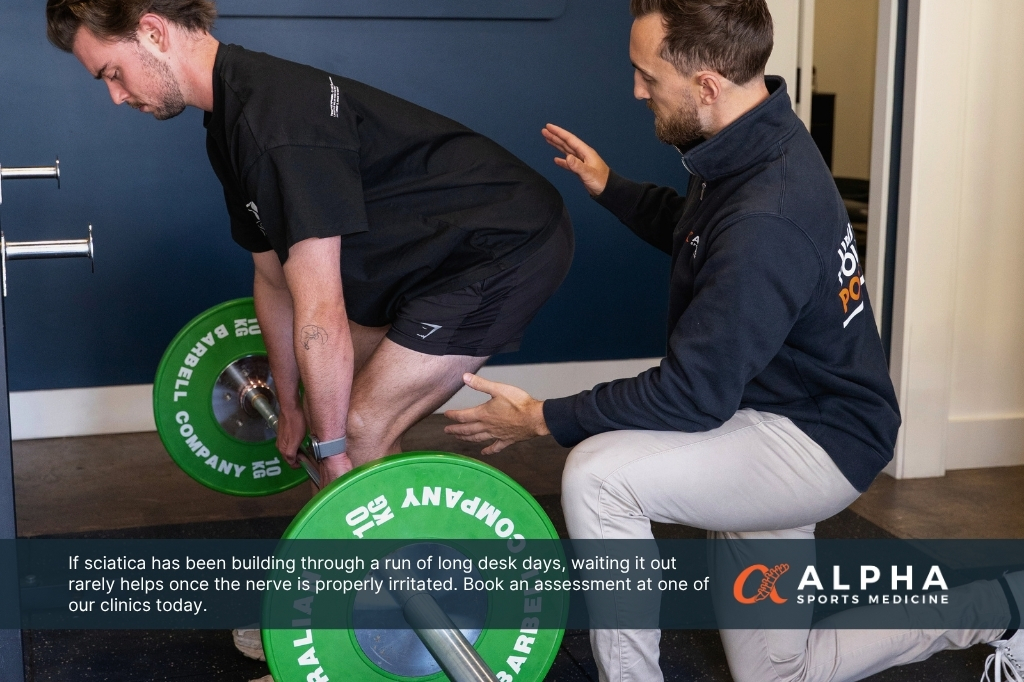
At Alpha Sports Medicine, our chiropractic care approach to sciatica starts with exactly that kind of assessment, taking a detailed history and running orthopaedic and neurological tests to establish what’s actually driving the pain before any treatment begins. For patients whose sciatica overlaps with broader lower back pain, addressing the spine and the desk habits together tends to produce a more lasting result than treating either in isolation.
If sciatica has been building through a run of long desk days, waiting it out rarely helps once the nerve is properly irritated. Book an assessment at our Newport, Ascot Vale, Bacchus Marsh, or Hawthorn clinic and get a clear picture of what’s driving the pain: alphasportsmed.com.au/contact-us