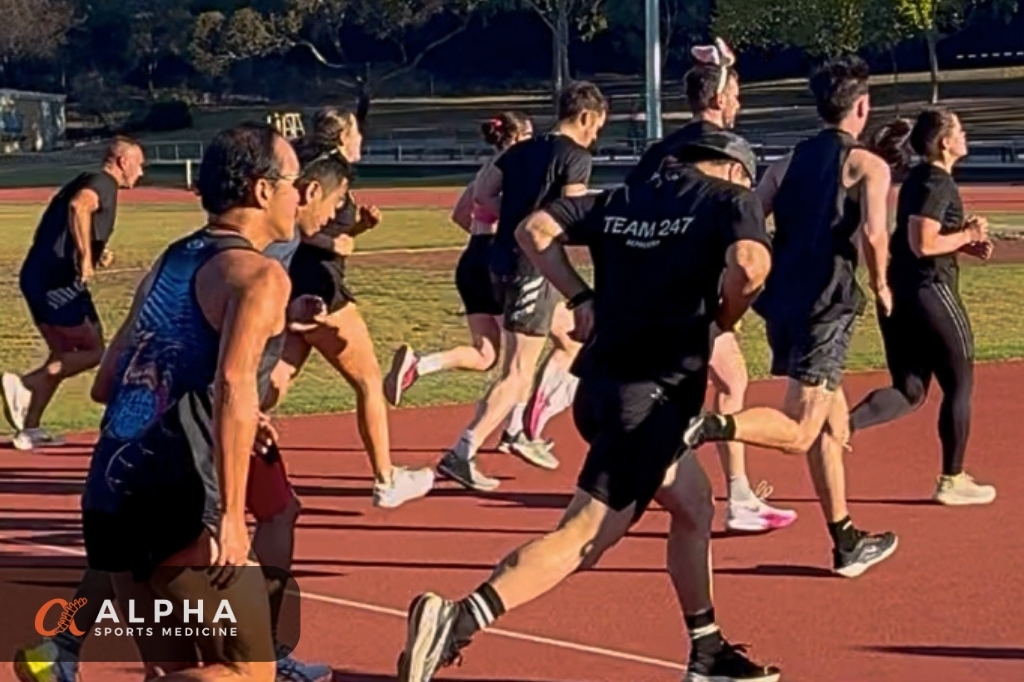
Crossing the finish line at the Sydney Opera House after 42.2 kilometres, legs across the Harbour Bridge and through North Sydney behind you, is one thing. Walking normally two days later is another. The TCS Sydney Marathon on 30 August drew one of the biggest fields the race has seen, and a lot of those finishers are about to learn that marathon recovery is its own kind of training block, one most runners spend far less time preparing for than the race itself.
Post-marathon recovery gets far less attention than marathon training does, which is a mismatch considering what the body has just been through. Whether you ran your first marathon or your tenth, understanding what’s actually happening in the days after 42.2 kilometres, and what genuinely helps, makes the difference between recovering well and turning normal soreness into something that lingers for months.
What Happens to Your Body After 42.2 Kilometres
Marathon muscle soreness isn’t like normal training soreness, and understanding why helps make sense of what’s coming in the days ahead. Muscle fibres, particularly in the quads and calves, sustain microscopic tears from the repeated eccentric loading of thousands of strides. Glycogen stores are largely depleted by the later kilometres, and the body shifts to relying more heavily on fat metabolism to keep moving. Inflammation builds throughout the tissues that absorbed the impact, which is part of why soreness tends to peak 24 to 48 hours after the race rather than immediately at the finish line.
This is delayed onset muscle soreness, commonly shortened to DOMS after a marathon, and for most finishers it’s a normal, expected response rather than a sign that anything has gone wrong. The soreness is usually symmetrical, affects the major muscle groups used in running, and gradually eases over three to five days. Joints and connective tissue, the achilles, the plantar fascia, the IT band, can also feel more reactive than usual for a similar stretch of time.
The First 72 Hours: What Actually Helps
Complete rest isn’t the best strategy for the days immediately after a marathon, despite how tempting the couch looks. Gentle movement, short, easy walks rather than sitting still for hours, helps circulate blood through fatigued tissue and tends to ease stiffness faster than total inactivity. Hydration and food matter more than most runners expect in the first 48 hours, since glycogen replenishment and tissue repair both depend on adequate fuel.
Sleep does more heavy lifting in recovery than almost any other single factor, and it’s the one most runners shortchange during a busy race weekend. Ice baths, compression garments, and foam rolling can offer some relief for soreness, though the evidence behind them is mixed, and none replace the basics of movement, food, and sleep. These marathon recovery tips aren’t complicated, but they get skipped constantly during a busy race weekend, especially when travel and celebrations are part of the picture too.
When Post-Marathon Soreness Is More Than DOMS
Ordinary DOMS follows a fairly predictable pattern: symmetrical, generalised, and improving day by day. A few signs point toward something that needs a closer look instead. Sharp, localised pain in one specific spot, particularly in the shin, foot, or hip, that isn’t easing after several days can indicate a stress reaction rather than simple muscle soreness. Swelling that doesn’t settle, pain that gets worse rather than better, or pain that changes how you’re walking are all reasons to get assessed rather than wait it out.
These signs overlap with the broader picture we cover in our guide to running injuries, and the same principle applies here: catching something early, before it’s had weeks to compound, almost always means a shorter path back to normal training.
How Osteopathy Supports Marathon Recovery
A lot of runners only think to see a post-race recovery osteopath once something hurts, but the weeks after a marathon are one of the more useful times to book in even without an obvious injury. A marathon training block builds up compensations, small movement patterns that develop as fatigue sets in over 16 or so weeks of training, and the race itself often exaggerates whichever pattern was already there. An osteopath can assess where load has accumulated unevenly through the hips, lower back, and legs, and address it before it turns into the next injury.
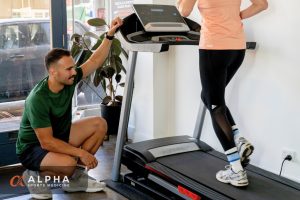
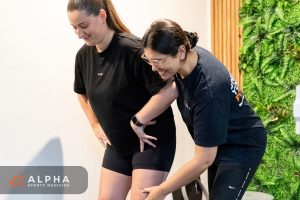
Treatment in the weeks after a marathon typically combines soft tissue work through the calves, quads, and glutes with joint mobilisation where stiffness has built up, particularly through the lower back and hips after hours of repetitive loading. Our osteopathy approach at Alpha Sports Medicine focuses on what your specific training block and race demanded of your body, rather than applying a generic post-race protocol to everyone who walks in.
Getting Back to Running After a Marathon
There’s no single correct timeline, but a general pattern holds for most recreational marathon finishers. The first week is generally light activity only: walking, easy cross-training if it feels good, and minimal to no running. Gentle running can often be reintroduced in the second week, at a pace and distance well below race effort, guided by how the body is responding rather than a fixed schedule. Building back to normal training volume typically takes three to six weeks, longer for a first marathon or an underprepared build, since the tissues that absorbed 42.2 kilometres of load need proportionate time to remodel and strengthen.
Post-Marathon Recovery: Your Questions Answered
| Question | Answer |
|---|---|
| How long does post-marathon soreness usually last? | For most runners, DOMS peaks around 24 to 48 hours after the race and eases over the following three to five days. Soreness that’s still significant after a week, or that’s worse in one specific spot rather than spread across the major muscle groups, is worth getting checked. |
| When can I run after a marathon? | Most recreational runners are better off avoiding running entirely for the first week, sticking to walking and gentle movement instead. Easy, short running can often be reintroduced in the second week, guided by how the body responds rather than a fixed number of days. |
| When should I see an osteopath after a marathon? | Anytime in the days to weeks following the race is reasonable, whether or not something feels obviously wrong. If pain is sharp, localised, worsening, or changing how you walk, book an assessment sooner rather than waiting it out. |
| Is it normal to feel new aches in areas that didn’t hurt during the race? | Yes, this is common. Adrenaline and race-day focus can mask discomfort that becomes noticeable once the body settles into recovery. Most of this is standard post-marathon soreness, though anything sharp, localised, or worsening over several days deserves a closer look. |
| How soon can I start training again after a marathon? | Most recreational runners can return to normal training volume within three to six weeks, though this varies with experience, training history, and how the body responds during the first couple of weeks back. A gradual build, rather than jumping straight back into pre-marathon mileage, gives tissues time to adapt. |
Rushing this stage is one of the more common ways a good marathon turns into months of nagging injury. The runners who take the recovery phase as seriously as the training block are usually the ones back to full training soonest.
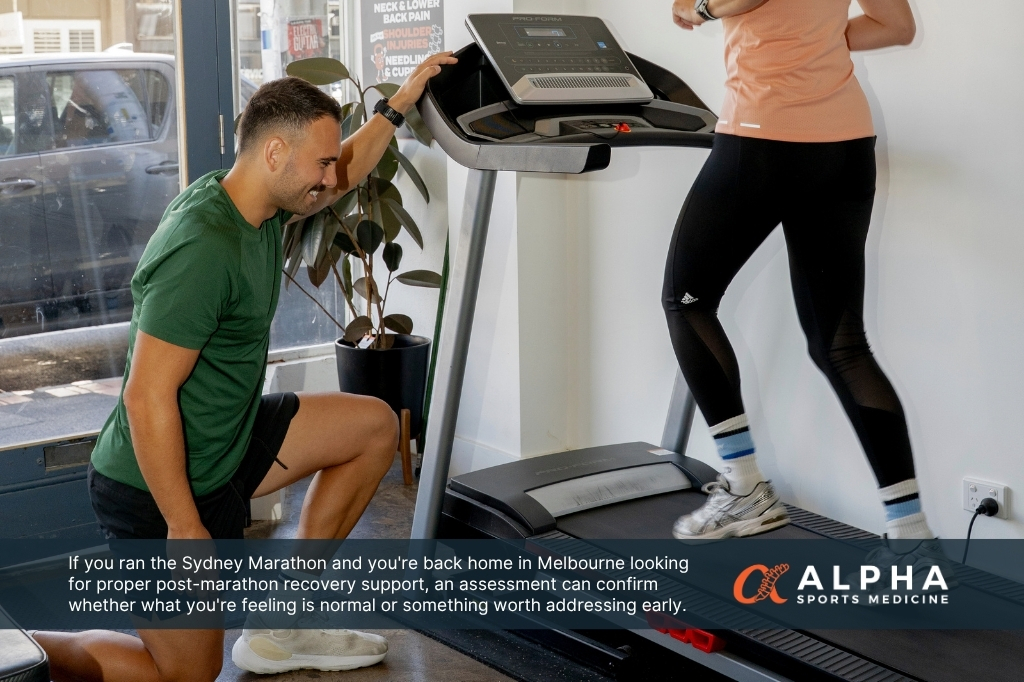
If you ran the Sydney Marathon and you’re back home in Melbourne looking for proper post-marathon recovery support, an assessment can confirm whether what you’re feeling is normal or something worth addressing early. Book at our Newport, Ascot Vale, Bacchus Marsh or Hawthorn clinic: alphasportsmed.com.au/contact-us